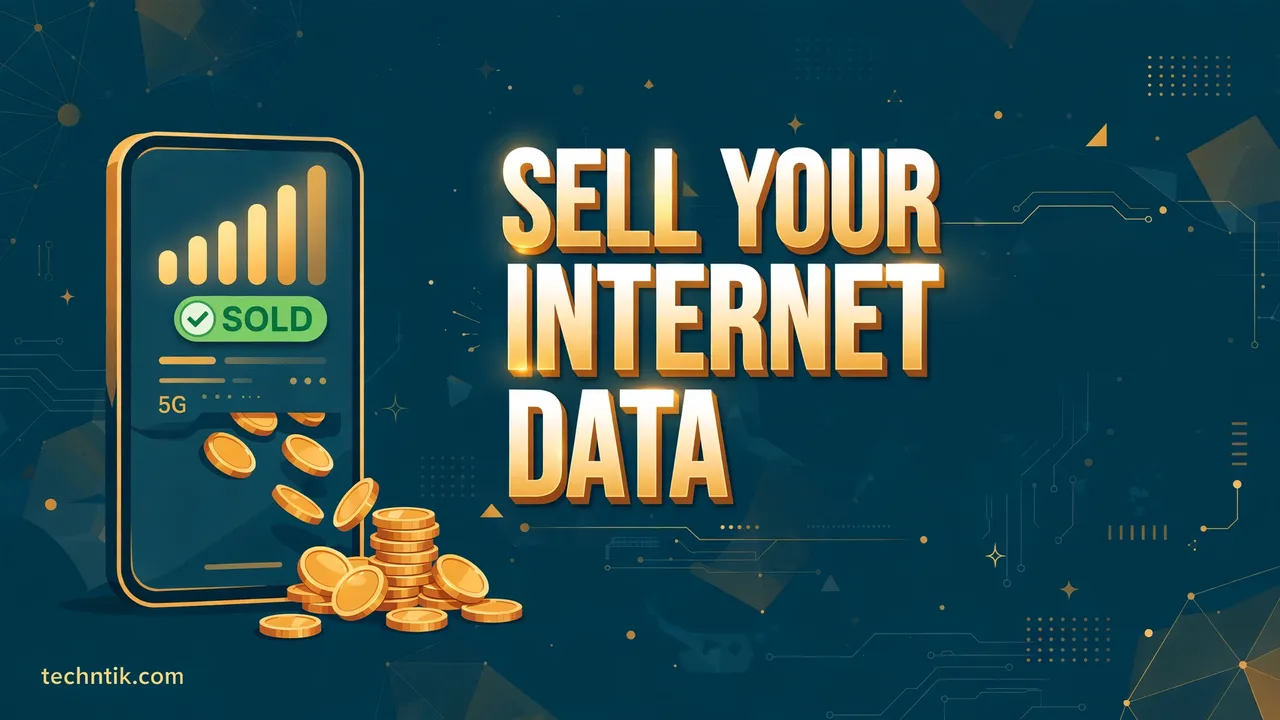
My cousin sent me a reel last week. A boy on Instagram was tapping his phone screen, and with every tap, money was landing in his account. The promise was simple. He had 5 GB of mobile data left in his monthly pack, he sold it through an app, and the app paid him for it. My cousin wanted to know if it was real, because he always has data left over too.
I have seen the same kind of video on TikTok too, many times now. The formula never changes. A screen recording, a balance going up, a payment screenshot at the end, and a link in the comments. So I did what I always do with a bold claim. I went back to the last time I tested an app this way, when a photo recovery tool taught me to read the official download page before believing any video.
What I found was two completely different stories hiding behind the same two words. One is a straight scam. The other is real, but it pays so little and carries risks that no reel ever mentions. Here is the truth about data selling apps, with the real numbers.
What the Videos Promise
The pitch is always the same. You pay for a data pack every month, and at the end of the month some data is left over. The video says that leftover data is money sitting in your phone. Install this app, sell the data you did not use, and get paid. Some videos show 50 MB selling for 500 rupees. Others show 500 MB turning into 850 rupees. The proof is always a screenshot of a wallet or a bank alert.
It sounds fair, which is why it spreads so fast. But the videos never explain who is buying your data or why anyone would pay 850 rupees for 500 MB when a full monthly pack with much more data costs less than that. That question is the whole story, and nobody in the video asks it.
The First Truth About Your Leftover Data
Here is the part the videos skip. There is no official way to sell the data left in your mobile pack. Jio, Airtel, Vi and BSNL do not run any program that lets you sell leftover MBs, and no real app does it either. Your data balance is not a thing you can hand to someone else. It is an allowance on your own connection, and when the pack ends, it ends with it.
So what are the apps in those videos? The ones I found are not on the Google Play Store at all. The videos send you to outside websites to install an APK file directly. One is called Internet Seller, another is DataCash Pro. They show a dashboard where your balance climbs as you tap, and a payment screen that says the money is on its way. Independent safety checks give these apps very low trust scores, and no verified proof exists that anyone ever received a real payment from them.
The warning signs are clear. A real app never asks for access to your SMS, your banking apps or your OTP to verify a data sale, and it never asks you to pay an activation fee before you can earn. If an app does any of these things, it is not a data selling app. It is a trap for your personal information, or for a fee you will never see again.
What the Real Apps Actually Do
Now the second story, which is real. Some apps pay you for your internet, but they do not buy your data balance. They buy your unused bandwidth, which means they route other people’s web traffic through your connection, usually your home WiFi, and pay you a small amount for each gigabyte that passes through.
The businesses on the other side use that traffic for market research, price monitoring and ad verification. The best known app in this space is Honeygain, a company from Lithuania that has been running since 2019. Others include PacketStream and EarnApp. Pawns.app used to do the same, but it has stopped bandwidth sharing on mobile phones.
None of these apps touches your mobile data pack. They run on WiFi or broadband, and they pay for the traffic that flows through your connection, not for the data you did not use. Running one on mobile data would cost you more than it pays.
What They Really Pay
This is where the reels fall apart completely. Honeygain, the biggest name here, pays about 10 cents per gigabyte. Its own site says you earn one credit for every 10 MB shared, and 10,000 credits are worth 10 dollars. The minimum payout is 20 dollars, which means you need to share about 200 GB before you can withdraw anything at all.
PacketStream pays the same, about 10 cents per gigabyte, with a 5 dollar minimum. Pawns.app paid about 20 cents per gigabyte when its sharing was active.
Now do the maths on the video’s own example. Your 5 GB of leftover data, at the real rate of 10 cents per gigabyte, is worth 50 cents. The video that promises 850 rupees for 500 MB is asking you to believe a rate about 170 times higher than the real one. No business on earth pays that, because nobody needs your leftover data that badly.
In practice, most people with one device earn between 1 and 10 dollars a month, roughly 200 to 1,000 rupees a month per device in India. One Pawns.app user reported earning only about 6 dollars over several months, and 5 of those dollars were a signup bonus, not sharing income.
The Risks Nobody Mentions in the Reels
The money is small. The risks are not. When you share your bandwidth, strangers send their web traffic through your IP address. If any of that traffic is used for something illegal, the trail leads back to you, because the connection is in your name. In June 2026, investigators published a report showing criminal and sanctioned traffic passing through Honeygain’s network. The company says it works with verified business clients, but you cannot see what flows through your own connection.
There is a second risk closer to home. Many internet providers do not allow you to resell or share your connection in their terms. If your provider finds out, your line can be suspended, and the complaint lands on your account, not on the app’s. Some security experts also flag this whole category as riskware, software that is not a virus but is not harmless either.
Mistakes to Avoid Before You Install Anything
The first mistake is installing an APK from a random website because a video told you to. The Play Store checks apps before listing them. An APK from outside has no check at all, and it can ask for permissions that a store app never could.
The second mistake is sharing an OTP or giving an app access to your messages or banking apps. No real earning app needs those things. An OTP is the key to your money, and anyone who asks for it is not verifying your data sale.
The third mistake is paying to start earning. If an app asks for an activation fee or a deposit before your first payout, walk away. Real bandwidth sharing apps are free to install. A fee to earn is a scam signal, not an investment.
The fourth mistake is expecting an income. Even the real apps pay pocket money, not a salary, and disappointment is what pushes people toward the next video with a bigger fake number.
The rule I follow before I download anything that promises money is simple. I check the official page first, and I decide after reading it, not after watching a video. It is the same rule I used for TikTok earning claims, and it has not let me down yet.
So What Should You Do Instead
If your data pack always has data left over, the honest fix is not an app. It is a smaller pack. Check how much data you actually use, and switch to a plan that matches it. The money you save is real, it arrives every month, and nobody needs your IP address for it.
If you still want to try bandwidth sharing, do it with your eyes open. Use WiFi only, never mobile data, and only the official site of a known app. Treat whatever comes back as a few coins for a coffee, not as earnings.
My cousin did not install the app from the reel. He checked his usage, found he uses about half his pack, and switched to a smaller one. He saves more every month than any data selling app would ever have paid him. That is the real trick, and no video will ever go viral for saying it.
1 thought on “I Checked the Data Selling Apps From Instagram and Here Is the Truth”