
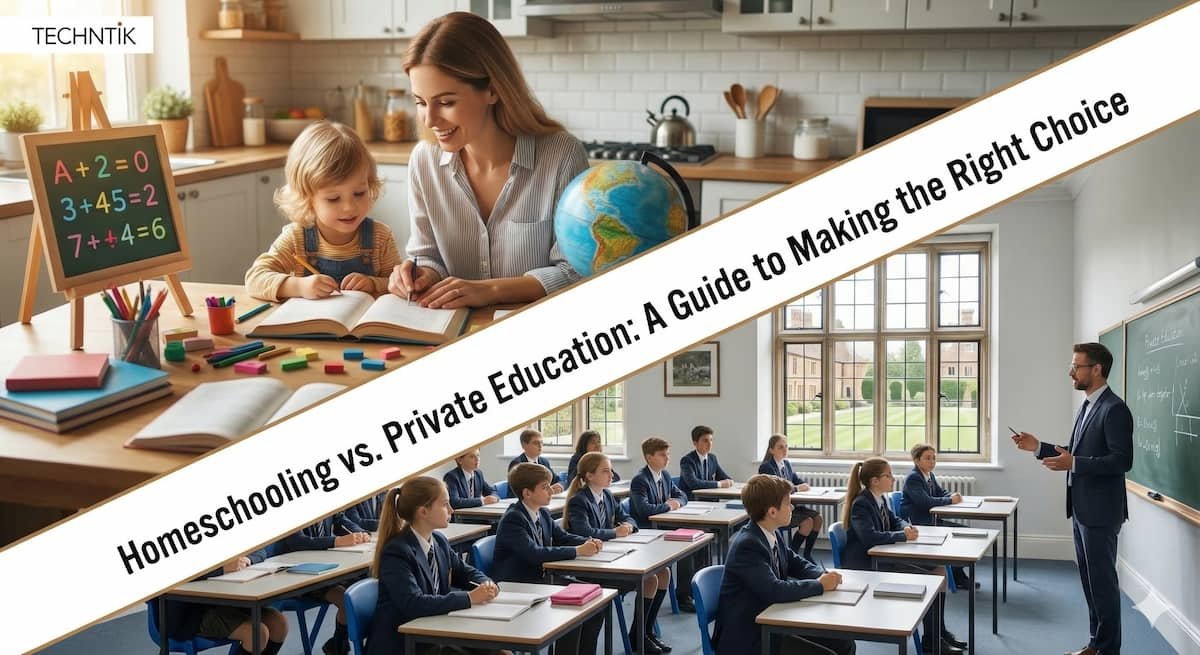
The debate between private education and homeschooling has never been more relevant. As dissatisfaction with mainstream schooling grows globally, and as digital resources make home-based learning more viable than ever, families are increasingly weighing these two alternatives against each other with genuine seriousness. The question is not which option sounds better in theory — it is which delivers measurably better outcomes for real children with real personalities, real learning needs, and real futures to navigate. The honest answer is that neither option is universally superior. Each delivers exceptional outcomes for the right child in the right circumstances, and catastrophic underservice for the wrong child in the wrong ones. Understanding where each model genuinely excels is the only basis for a decision that serves a child rather than a parenting philosophy.
Academic Outcomes and Socialization: What Research Actually Shows
The academic evidence on both models is more nuanced than advocates on either side typically acknowledge. Homeschooled students consistently perform well on standardized assessments — multiple large-scale studies show homeschooled children outperforming public school peers and performing comparably to private school students in core academic skills. However, these studies carry a significant selection bias: families who homeschool tend to be highly educated, highly motivated, and intensely invested in their children’s learning — variables that predict strong outcomes regardless of educational setting.
Private education — particularly at institutions offering rigorous frameworks like the IB school curriculum — delivers documented advantages in university preparation, critical thinking development, and access to specialist teaching that most homeschool environments cannot replicate. An IB school graduate has studied under qualified subject specialists, completed externally assessed examinations recognized by universities worldwide, and developed the organizational and intellectual habits that demanding higher education requires. These are structural advantages that even the most committed homeschooling parent struggles to reproduce.
Socialization — the most common concern raised about homeschooling — is more complex than the criticism implies. Research does not support the idea that homeschooled children are universally socially underdeveloped. Children in well-designed homeschool programs with active community engagement, sports participation, and peer interaction develop social competence effectively. The risk is not homeschooling per se but isolation — programs that fail to build genuine, regular, diverse social contact alongside academic learning.
| Private School | Homeschooling | |
|---|---|---|
| Academic specialist access | High — qualified subject teachers | Limited — parent capability dependent |
| Social development | Structured, daily peer interaction | Variable — requires deliberate effort |
| Curriculum flexibility | Moderate — within school framework | Maximum — fully customizable |
| University recognition | Strong — established qualifications | Growing — varies by institution |
| Cost | High tuition fees | Lower — but significant time investment |
| Extracurricular breadth | Extensive — sports, arts, competitions | Limited — requires external sourcing |
Hybrid Approaches and University Admissions Reality
The most interesting development in this debate is the emergence of hybrid models that deliberately combine the strengths of both approaches. Microschools, learning pods, and part-time enrollment arrangements allow families to access specialist private education teaching in core subjects while maintaining the flexibility and personalization of home-based learning for others. Trinity‘s academic philosophy — that education should respond to the individual learner rather than force the learner to conform to a fixed system — is something that thoughtful hybrid approaches genuinely embody, even outside formal institutional settings.
What families considering hybrid or homeschool routes must understand clearly:
- University admissions offices assess non-traditional applicants differently — not worse, but differently, requiring more proactive documentation of learning and achievement
- External examination entry as a private candidate is possible but requires deliberate planning, fee investment, and finding approved examination centers independently
- IB school qualifications and A-Levels carry immediate international recognition that portfolio-based homeschool transcripts do not — a meaningful practical disadvantage for globally ambitious students
- Extracurricular achievement — sports representation, music examinations, debating competitions — requires significantly more parental effort to source and coordinate outside a private education institution
- The social infrastructure of private school life — the friendships, the shared experiences, the alumni network — cannot be replicated through homeschooling regardless of academic quality
The decision ultimately comes down to a precise understanding of what a specific child needs. A highly self-directed, academically advanced child with a deeply educated and available parent may genuinely thrive in a well-designed homeschool environment. A child who is socially motivated, benefits from external accountability, and has university ambitions requiring recognized qualifications will almost certainly be better served by serious private education — where the structural, social, and academic resources exist at a level that home-based learning, however lovingly designed, cannot match.

