

When setting up a solar panel system, ensuring safety and reliability is crucial. A miniature circuit breaker (MCB) serves as a vital component for protecting solar systems from electrical issues, such as overloads and short circuits. Choosing the right MCB is essential for preventing damage and enhancing the efficiency of the solar installation. This guide will cover key factors in selecting and installing an MCB, providing essential insights for both novice and experienced users alike.
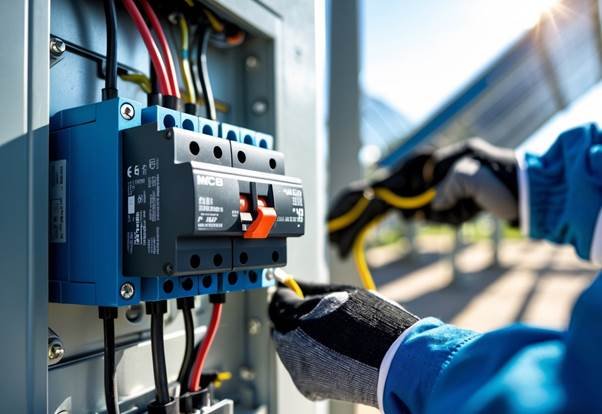
Solar panel circuit breakers offer overcurrent protection, which is critical in managing the flow of electricity generated by solar panels. These DC breakers are specifically designed to handle the direct current produced by solar installations, distinguishing them from standard AC breakers. Understanding the unique requirements of the solar system can help in selecting the appropriate breaker that maximizes safety and performance.
With the right knowledge and careful selection, users can build a robust and efficient solar power system. This article will explore important aspects, such as sizing, voltage ratings, and installation practices, ensuring users are well-equipped to safeguard their solar investments.
Role and Importance of MCBs in Solar Power Systems
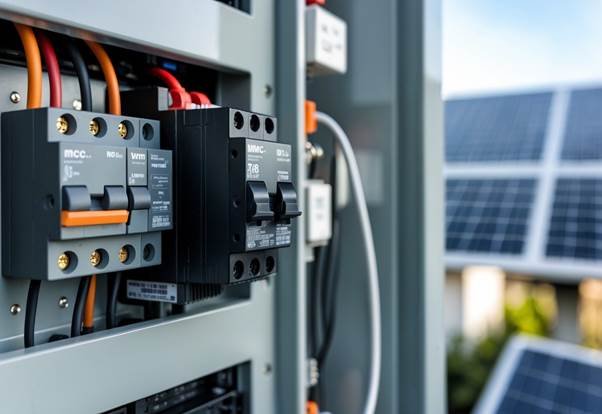
Miniature circuit breakers (MCBs) play a vital role in enhancing the safety and reliability of solar power systems. Their protective functions help prevent damage from faults while ensuring safe operation across various components, including solar panels, inverters, and battery banks.
Key Protective Functions and Safety Benefits
MCBs offer essential features for protecting solar power installations from overcurrent conditions. These devices automatically trip when excessive current is detected, cutting off the electrical flow. This action protects the system from potential damage, including wiring overheating and appliance failure.
- Overload Protection: MCBs prevent excessive current flow, which can be harmful to solar panels and connected devices.
- Short-Circuit Protection: In case of a short circuit, MCBs help prevent fire hazards by rapidly disconnecting the affected circuit.
- Maintenance Safety: With MCBs, technicians can safely disconnect parts of the system for routine maintenance, reducing the risk of electric shock.
By utilizing DC MCBs specifically designed for direct current, a common type in solar systems, safety and performance are significantly improved.
Placement Within PV Arrays and Battery Banks
The placement of MCBs is crucial for effective protection in solar systems. In typical PV array setups, MCBs are installed in combiner boxes at the junction of multiple strings of solar panels. This placement ensures that faults in one string do not affect the entire array’s performance.
In battery banks, MCBs play a similar role. They protect against overload and fault conditions during both charging and discharging cycles. Proper placement is critical, often positioned between the charge controller and batteries to safeguard the battery bank from potential risks.
When installed correctly, MCBs enable the safe isolation of sections of the system during maintenance or in case of faults, improving overall system reliability and safety.
Differences Between DC and AC Applications
MCBs designed for DC applications operate differently compared to their AC counterparts. In solar setups, DC MCBs manage current that flows in one direction from solar panels to batteries and inverters.
- Arc Interruption: DC current does not have a natural zero-crossing point, making it challenging to interrupt arcs effectively. As such, DC breakers are designed with special arc extinguishing features.
- Voltage Ratings: Typical residential solar systems may use DC MCBs rated from 600V to 1000V, while larger systems could require ratings up to 1500V. AC MCB ratings vary based on the specific application but may not need such high voltage thresholds.
- Current Ratings: For solar applications, MCB ratings often range from 15A to 30A for protection of PV strings, while battery systems may need higher ratings, typically between 50A to 200A, depending on the system capacity.
These design features make solar circuit breakers and battery circuit breakers critical for ensuring safe and efficient operations within solar power systems.
Types and Ratings of MCBs for Solar
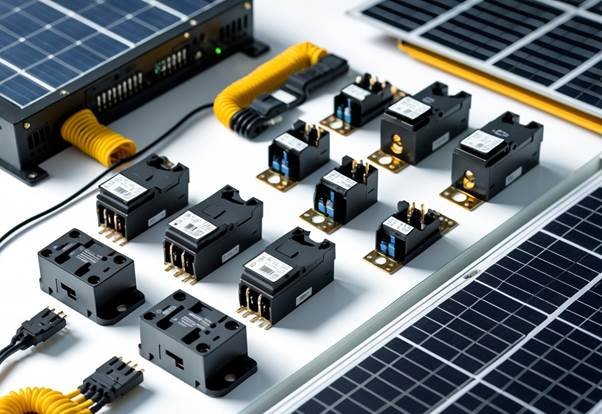
Selecting the right types and ratings of Miniature Circuit Breakers (MCBs) is crucial for ensuring the safety and efficiency of solar panel systems. Different varieties exist, each suited for specific functions, and understanding current and voltage ratings is essential for proper integration.
DC Miniature Circuit Breaker Varieties
DC Miniature Circuit Breakers come in several types designed specifically for solar applications. The most common types are Type B and Type C. Type B MCBs are sensitive to small overloads, making them suitable for lighting and low-power applications. In contrast, Type C breakers handle larger inrush currents, making them ideal for inductive loads like motors or transformers often found in solar systems.
DC-rated breakers differ from AC-rated ones due to the unique characteristics of direct current. They are built to safely interrupt the flow of current when necessary. These breakers are also available in various pole configurations, typically single-pole or double-pole, to accommodate a variety of circuit setups. For example, a single-pole MCB might be used for a single string of solar panels, while a double-pole MCB is suitable for larger arrays requiring two connections.
Single-Pole vs. Double-Pole MCBs
Single-pole MCBs are designed to protect one wire in a circuit, making them suitable for small solar systems or individual panel setups. They typically handle lower loads and are simpler to install. Conversely, double-pole MCBs protect both the positive and negative wires, providing enhanced safety for higher voltage applications, such as those reaching up to 1000V DC.
The choice between single-pole and double-pole breakers hinges on system needs. For larger installations, double-pole breakers are often required to ensure both lines are adequately protected. This arrangement prevents current backflow and minimizes risks associated with DC current, making it essential for solar energy systems that require reliable circuit protection.
Voltage and Current Rating Considerations
When selecting an MCB for solar systems, attention to voltage and current ratings is paramount. The voltage rating must match or exceed the highest voltage produced by the solar panels. For example, a system that operates at 600V DC should use breakers rated for at least 600V. Using an MCB rated below the system voltage can lead to failure or malfunction.
Current ratings also play a significant role. The breaker should handle the maximum expected current without tripping unnecessarily. Many systems incorporate a safety factor, often multiplying the maximum current by 1.25, to determine the appropriate rating. Understanding the breaking capacity, or how much fault current the MCB can handle, is equally important. A higher interrupt rating reduces the risk of damage during shorts, ensuring safe and dependable operation of the solar energy system.
Selection Criteria and Sizing Calculations
Choosing the right MCB for solar panel systems involves specific criteria to ensure safe and efficient operation. Factors such as voltage, current ratings, and standards play a crucial role in the selection process. Understanding these aspects can help in making an informed choice.
Matching MCBs to System Voltage and Current
The first step in selecting an MCB is to match its ratings to the solar system’s voltage and current requirements. For instance, if a solar system operates at an open-circuit voltage (Voc) of 48V, the MCB must support at least this voltage.
Consider the current as well. The MCB needs to handle the maximum fault current (If) which is the highest current that can occur during a short circuit. It’s recommended to use MCBs that can manage at least 1.25 times the system’s continuous current (Isc).
Example Parameters:
| Parameter | Example Value |
| System Voltage | 48V |
| Continuous Current (Isc) | 40A |
| Minimum MCB Rating | 50A |
Choosing an MCB with proper ratings ensures it will not trip unnecessarily while providing protection when needed.
Application of Certifications and Standards
Certifications and standards are critical when selecting an MCB. Compliance with standards such as UL 489 and IEC 60947 ensures that the breaker meets safety and reliability requirements.
UL 489 is crucial for protection against overloads and short circuits, while IEC 60947 covers safety and performance criteria across various applications.
In the United States, NEC Article 690 outlines specific requirements for solar installations to enhance safety and reduce risks. Always verify that the selected MCB complies with relevant local and international standards for quality assurance.
Environmental Factors and Derating
Environmental conditions can affect an MCB’s performance. Factors such as temperature, humidity, and altitude may necessitate derating the MCB. Derating refers to using a lower capacity than the rated value, ensuring the breaker functions safely under certain conditions.
For instance, if the ambient temperature exceeds 30°C, the MCB might need to be derated by 10%. It’s also important to consult derating curves provided by manufacturers to accurately determine the necessary adjustments.
Key Considerations:
- Temperature: Higher temperatures can reduce carrying capacity.
- Humidity: Increased humidity can affect insulation and performance.
- Altitude: Higher altitudes may require additional derating.
By taking these environmental factors into account, the selected MCB will perform reliably and effectively over time.
Proper Installation and Wiring Practices
Proper installation and wiring practices are crucial for the safe and effective functioning of MCBs in solar panel systems. Key considerations include ensuring correct polarity, optimal placement, and choosing the right cables for the application. These practices minimize risks and enhance performance.
Correct Polarity and Polarity Marking
Ensuring correct polarity is vital when installing an MCB in solar systems. The positive and negative wires must be correctly connected to prevent malfunction or damage. Incorrect connections can lead to short circuits or equipment failure. Polarity marking on the MCB helps prevent mistakes.
Tips for Correct Polarity:
- Identify Wires: Use color-coding (red for positive, black for negative) to avoid confusion.
- Check Markings: Ensure that polarity markings on the MCB match the wiring.
- Regular Checks: Confirm that connections are secure and correctly aligned during installation.
Recommended Placement for Maximum Safety
Placement of the MCB should be strategic for maximized safety. Installing it near the battery bank is recommended. This reduces the risk of electrical faults occurring before reaching the breaker. Proper placement helps mitigate potential hazards.
Placement Guidelines:
- Near Battery Bank: Position the MCB as close as possible to the battery bank.
- Accessibility: Ensure easy access for maintenance and inspections.
- Avoid Hazards: Keep MCB away from any water sources or areas with high humidity.
Cable Selection and Wiring Guidelines
Selecting the right cable size is critical for the installation. Cables must match both the voltage and current ratings of the solar system. The correct wire size prevents overheating and energy loss.
Wiring Guidelines:
- Wire Size: Use cables rated for the maximum current output, typically following the rule of thumb that larger cables can handle higher loads safely.
- Connectors: Employ appropriate connectors, such as those used in a solar combiner box, to maintain secure connections.
- Secure Wiring: Attach wires firmly to the DIN rail or mounting structure, ensuring they are intact and not subject to wear or damage.
Using these practices, individuals can maximize the safety and efficiency of MCB installations in solar panel systems.
Maintenance, Troubleshooting, and Best Practices
Regular maintenance and problem-solving practices are essential for the effective operation of solar panel systems. Proper attention helps ensure safety, extends the lifespan of equipment, and minimizes unexpected issues.
Routine Checks and Preventive Maintenance
Regular inspections are key for the performance of MCBs in solar panel systems. Check the following components every few months:
- Connection Points: Ensure all connections are tight. Loose connections can cause overheating and failures.
- Physical Damage: Inspect for signs of wear or damage to the circuit breaker and wiring. Cracks, corrosion, or burning can indicate serious issues.
- Ambient Conditions: Keep the area around the MCB clean and dry. Dust and moisture can hinder operation and lead to malfunction.
Additionally, it is crucial to verify that the circuit breaker ratings match or exceed the system requirements. Routine checks should also include testing functionality using a multimeter to ensure it can handle fault currents effectively. Regularly replacing worn-out components can prevent larger issues down the line.
Addressing Arc Suppression and DC Arcs
Arc suppression in DC systems is vital for safety and reliability. An arc occurs when there is a gap in circuitry, causing current to jump and possibly leading to fires or equipment damage.
To address this:
- Use Proper Breakers: Employ DC-rated MCBs for solar applications. These are designed to handle the specific characteristics of DC arcs.
- Consider GFCI and AFCI Protection: Ground Fault Circuit Interrupters (GFCI) and Arc-Fault Circuit Interrupters (AFCI) are crucial for minimizing risks from electrical faults. They detect irregularities and quickly interrupt the circuit, enhancing safety.
- Monitor Performance: Keep an eye on the performance of the breakers. Any unusual sounds or trips may indicate arc-related issues that require immediate attention.
Maintaining effective arc suppression systems will not only protect the equipment but also ensure enhanced operational efficiency.
Replacing or Upgrading Breakers
Circuit breakers may need replacement or upgrade to meet evolving system demands. Key indicators include:
- Frequent Tripping: If a breaker trips often, it may be undersized or malfunctioning. Replacing it with a model that accommodates the system’s fault current is essential.
- System Expansion: As solar systems expand, original breakers might not suffice for higher loads. Upgrading to appropriately rated breakers ensures safety and performance.
- Aging Components: If the circuit breaker shows signs of age, such as rust or wear, they should be replaced promptly.
It’s important to choose breakers compatible with the system specifications, ensuring reliability and safety. For example, using breakers with adequate breaking capacity will protect against high fault currents generated during surges. Regular assessments can guide necessary upgrades to keep the solar panel system performing optimally.
