
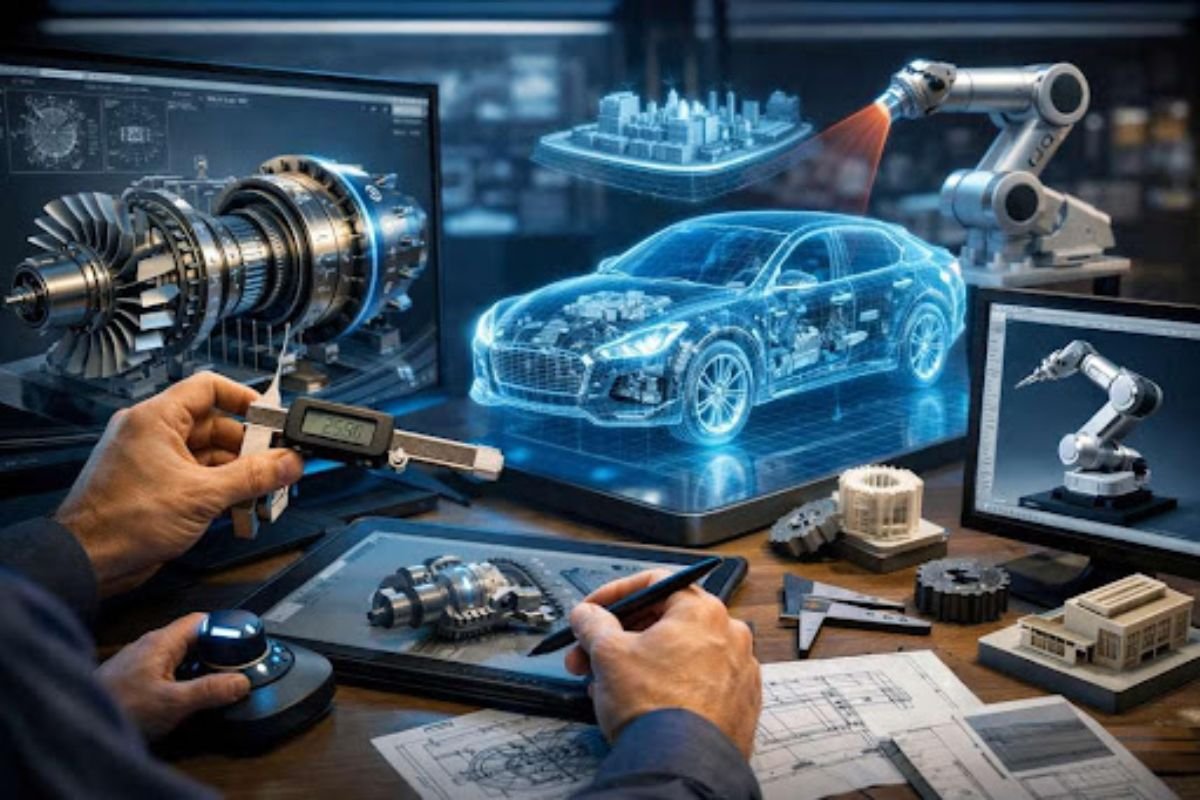
Precision is the silent driver behind every successful product, structure, and engineered system. Whether it’s a complex aerospace component, a medical device, or a modular construction unit in London, accuracy determines performance, safety, and profitability.
Yet achieving high-precision design is becoming increasingly challenging. Projects are more complex. Regulations are stricter. Timelines are shorter. And client expectations are higher than ever.
This is why businesses across the UK and globally are investing in Custom 3D Modeling Services. From startups developing innovative products to established engineering firms managing multimillion-pound infrastructure projects, digital precision has become a strategic necessity.
But what exactly makes custom modeling so valuable in high-precision environments? And why are experts calling it a cornerstone of modern CAD workflows?
Let’s explore.
Why Is High-Precision Design So Critical Today?
In industries such as manufacturing, architecture, civil engineering, and product development, even small dimensional inaccuracies can trigger significant downstream issues.
Common consequences of design imprecision include:
- Assembly misalignment
- Structural weaknesses
- Compliance rejections
- Production delays
- Material waste
According to research published by McKinsey & Company, large construction and engineering projects often run 20% over schedule and up to 80% over budget, with coordination and design errors playing a major role. Digital precision dramatically reduces these risks.
For UK-based firms operating under stringent building regulations and ISO standards, maintaining accuracy is not optional, it’s essential.
This is where Custom 3D Modeling Services provide measurable value.
What Are Custom 3D Modeling Services?
Unlike generic 3D visualizations, Custom 3D Modeling Services are tailored to exact project specifications, technical tolerances, and functional requirements.
They typically include:
- Parametric modeling
- Tolerance analysis
- Structural and mechanical simulations
- Assembly validation
- Integrated documentation workflows
When combined with professional 3D CAD Modeling Services, these digital models become intelligent representations capable of simulating real-world conditions before any physical production begins.
This predictive capability is what makes them indispensable in high-precision design.
How Do Custom 3D Modeling Services Improve Design Accuracy?
1. Parametric Precision
Parametric modeling allows engineers and designers to define relationships between dimensions. When one parameter changes, related elements automatically update.
This eliminates manual redrawing errors and ensures consistency across complex assemblies.
2. Advanced Simulation and Testing
Modern 3D CAD Modeling and Design Services allow teams to simulate:
- Load distribution
- Stress resistance
- Thermal behavior
- Movement dynamics
This enables early detection of structural vulnerabilities, reducing reliance on costly trial-and-error prototyping.
3. Early Clash Detection
Integrated 2D & 3D Modeling Services support clash detection across disciplines architectural, structural, mechanical, and civil systems.
Catching these conflicts digitally saves significant time and resources during construction or manufacturing.
Why Is the UK Driving Adoption of Custom 3D Modeling?
The UK’s AEC and manufacturing sectors are undergoing accelerated digital transformation.
Key drivers include:
- BIM compliance requirements
- Stricter safety and environmental regulations
- Expansion of offsite and modular construction
- Investment in advanced manufacturing technologies
According to the UK BIM Framework, structured digital information management is becoming standard practice across public-sector projects.
This has fueled demand for highly accurate CAD Modeling Services that align with digital project delivery standards.
How Does Precision Reduce Production Risks?
High-precision design has a direct impact on production outcomes.
Here’s how Custom 3D Modeling Services reduce risk:
• Minimized Material Waste
Accurate digital models ensure optimized material calculations and reduce over-ordering.
• Improved Assembly Efficiency
Validating component fit digitally prevents on-site misalignment issues.
• Reduced Rework
When design conflicts are resolved early, costly late-stage modifications are avoided.
• Enhanced Compliance Confidence
Precise models align better with regulatory submissions and quality standards.
For UK engineering firms navigating strict compliance frameworks, this reliability is invaluable.
How Do Custom 3D Modeling Services Support Innovation?
Precision is not just about avoiding errors it also empowers innovation.
Startups and product designers can use digital modeling to:
- Explore multiple design iterations rapidly
- Validate ergonomic functionality
- Improve aesthetic detailing
- Test performance scenarios
Advanced 3D CAD Modeling Services allow experimentation without the financial risk of physical prototyping.
This agility is especially beneficial for tech startups and SMEs competing in global markets.
What Role Does Integration with 2D Drawings Play?
Although 3D modeling is powerful, 2D documentation remains essential for construction permits, manufacturing, and compliance approvals.
Integrated 2D & 3D Modeling Services ensure:
- Drawings are generated directly from the 3D model
- Revisions update automatically
- Documentation reflects accurate geometry
- Fabrication drawings remain consistent
Without integration, discrepancies between models and drawings can introduce costly errors.
Seamless synchronization strengthens quality control.
How Are Automation and AI Shaping High-Precision Modeling?
Technology is rapidly enhancing modeling capabilities.
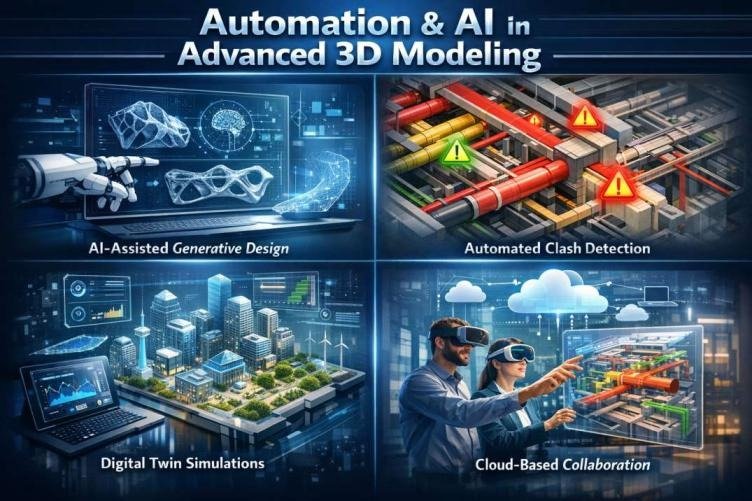
Today’s leading 3D Modeling Company solutions often integrate:
- AI-assisted generative design
- Automated clash detection
- Digital twin simulations
- Cloud-based collaboration
Research from PwC UK highlights growing investment in digital construction and manufacturing technologies to improve productivity and resilience.
Automation enhances precision while accelerating delivery timelines.
Which Industries Benefit the Most?
High-precision modeling supports a wide range of industries, including:
- Aerospace and automotive engineering
- Industrial machinery manufacturing
- Medical device production
- Architectural and structural design
- Civil infrastructure development
Across these sectors, even minor deviations can affect safety, functionality, and regulatory approval.
This makes professional CAD Modeling Services an operational safeguard.
What Challenges Should Businesses Consider?
Despite clear benefits, companies should address a few implementation considerations:
- Ensuring software interoperability
- Protecting intellectual property and data security
- Training teams on digital workflows
- Choosing an experienced modeling partner
Selecting a reliable 3D Modeling Company with expertise in UK compliance standards can significantly reduce these barriers.
How Can SMEs and Startups Leverage Custom Modeling?
You don’t need a large in-house design department to benefit.
Many SMEs choose to outsource complex tasks to providers of 3D CAD Modeling and Design Services.
Advantages include:
- Access to specialist expertise
- Reduced operational overhead
- Flexible scalability
- Faster turnaround times
For startups presenting investor prototypes or applying for grants, professional digital models enhance credibility and confidence.
What Does the Future Hold for Custom 3D Modeling Services?
The future of high-precision design is digital, intelligent, and interconnected.
Expect continued growth in:
- Real-time cloud collaboration
- Digital twin ecosystems
- Sustainability-focused modeling
- AI-driven predictive simulations
- Lifecycle performance analysis
As compliance requirements become more demanding and sustainability standards tighten, precision will become even more critical.
Businesses that adopt integrated 2D & 3D Modeling Services now will be better positioned to navigate evolving industry expectations.
Final Thoughts
High-precision design is no longer a luxury; it is a foundational requirement for modern engineering and construction.
Custom 3D Modeling Services provide:
- Greater dimensional accuracy
- Reduced production risk
- Faster innovation cycles
- Improved compliance confidence
- Enhanced cross-disciplinary coordination
For UK-based firms and global enterprises alike, digital precision is becoming the benchmark for competitive advantage.
Many forward-thinking organisations are quietly collaborating with experienced UK CAD specialists who combine advanced technical modeling expertise with deep regulatory understanding ensuring that designs transition from concept to execution with minimal risk and maximum accuracy.
In an industry where even minor miscalculations can carry major consequences, precision isn’t just technical, it’s strategic.
FAQs:
1. What are Custom 3D Modeling Services?
Custom 3D Modeling Services involve creating highly detailed, project-specific digital models tailored to exact design specifications, tolerances, and functional requirements before physical production begins.
2. Why are Custom 3D Modeling Services important for high-precision design?
They help validate dimensions, test structural integrity, simulate performance conditions, and detect design flaws early, reducing costly errors in manufacturing and construction.
3. How do Custom 3D Modeling Services benefit UK engineering firms?
UK engineering and construction firms use Custom 3D Modeling Services to meet strict building regulations, BIM standards, and compliance requirements while improving coordination and reducing rework.
4. What is the difference between 3D CAD Modeling Services and Custom 3D Modeling Services?
3D CAD Modeling Services provide digital design models, while Custom 3D Modeling Services tailor those models to unique project requirements, precision tolerances, and performance simulations.
5. Are 2D drawings still needed with 3D modeling?
Yes. Integrated 2D & 3D Modeling Services ensure that technical drawings, compliance documentation, and fabrication details align accurately with the 3D model.
6. How do Custom 3D Modeling Services reduce production risks?
They minimize risks by identifying dimensional inconsistencies, preventing assembly conflicts, optimizing material usage, and validating regulatory compliance before production begins.
7. Which industries benefit most from Custom 3D Modeling Services?
Industries such as aerospace, automotive, construction, manufacturing, product design, and infrastructure development benefit significantly from high-precision digital modeling.
8. Can startups use Custom 3D Modeling Services?
Yes. Startups leverage Custom 3D Modeling Services to develop investor-ready prototypes, test product feasibility, and reduce early-stage production errors.
9. Is outsourcing to a 3D Modeling Company cost-effective?
Partnering with a specialized 3D Modeling Company can reduce overhead costs, provide access to expert talent, and improve turnaround times without expanding internal teams.
10. What is the future of Custom 3D Modeling Services in the UK?
The future includes AI-assisted design, digital twin integration, cloud collaboration, and sustainability-driven modeling standards that enhance precision and project control.

